If it was the prevalence of the notion that the Indian sub-continent was a land laden with knowledge, riches and economic opportunity – the metaphorical ‘Golden Bird’, it was this very notion that attracted foreign interests, ultimately paving the way to the demise of this notion. A wide array of historical accounts from early travellers and historians Fa Xian, Xuan Tsang, Pliny the Elder, Ibn Battuta inter alia all depicted India in glowing terms as a “prosperous land of opportunity” and the global forerunner in trade, with its agricultural and industrial sectors thriving.
This notion persisted as late as the sixteenth century, attributable to the sheer visible stock in terms of luxurious commodities and the ludicrously opulent lifestyles of the upper and ruling classes. British Historian – W.H. Moreland (writing in the early 20th Century) questioned the veracity of this notion in purporting that the true poverty plaguing the nation was masked by the luxury and exuberance of the court life, the international trade in silks and muslins, the sizeable splendour of some Indian cities, the disdain for European products – these were the reasons why Moghul India was regarded as wealthy by some European travellers.
Despite the standards of living of the upper classes being much higher than that of their European counterparts, there is substantial evidence that the mass of the population was worse off than in Europe. The inference made here was that the Mughal economy was at its peak under Jalaluddin Akbar (1556-1605) and steadily declined thereafter. Notwithstanding that economically at its zenith – the per capita product in Mughal India was comparable with that of Elizabethan England, however, by the mid-eighteenth century, post the colonisation of the subcontinent, Moreland remarks that India under the was desperately poor and the economy was ostensibly retarded – with a per capita product of merely two-thirds of that prevalent in England and France.
Nevertheless, albeit Moreland rather myopically jumping to the conclusion that Colonial India was much better off than Mughal India based, however, historical records are indicative of otherwise. In pursuance of this discussion, this paper endeavours to examine the sources of income of various classes of society in the Mughal India and analyses their standards of living. The paper shall be structured in three separate parts: the first part of the paper will encapsulate the rural, countryside of Mughal India and shall discuss specifically the sources of income of the peasantry and other rural classes; secondly, the focus shall be averted to the urban avenues under Mughal India – wherein the umbrella term of “middle class” that was accorded to officials and members of professional classes shall be explored; lastly, the exuberance and opulent standards of living of the ‘upper class’ – comprising of the nobles and merchants shall be scrutinised.
COUNTRYSIDE HINDUSTAN IN THE MUGHAL ERA
If one were to paint a picture of the countryside in Mughal India, contrary to the perception of select occidental historians, it would not be one of acute discontent. In the words of eminent historian Satish Chandra: the villages borne sorrows and joys in equanimity. Make no mistake, the majority of these peoples were indeed poor – both by the sixteenth century and modern-day standards. However, all their fundamental requirements for leading a basic life and sustenance were met, including the then conventional – one meal a day (a practice continued in most of rural India till date).
The cultivators of the soil included three distinguishable classes in terms of social standing and hierarchy (in descending order) viz. Firstly the khud-kasht, also referred to as the malik-i-zamin, (literally translating into owners of the deed of land) were the original proprietors of the soil they tilled; Secondly, the upari or pahi-kasht comprised of migrant peasants traversing from other villages to cultivate land and thereby lacked the privileges and position accorded to the class of khud-kashts; Thridly, the Muzari’an or the share-croppers was a small class of landless peasants who often received a fixed share of the harvest for their efforts and whose societal standing was concomitant to that of the lowly servant classes such as the tanners, the washermen and the potter.
Roti
The common folk of most parts of India consumed a diet comprising chiefly of rice millets and pulses. However, regional and cultural variances meant that the eastern and southern parts of the subcontinent had a rice-based diet (supplemented with fish and other seafood in areas near the coast and inland rivers). In fact, contemporary historian Irfan Habib argues that generally speaking, the lowest variety of his produce was taken out by the peasant for his personal consumption. This was often augmented by herbs, beans and other vegetables according to the accounts of French traveller and historian Jean-Baptise Tavernier. The consumption of meat was highly infrequent, especially with a taboo on beef and pork among Hindus and Muslims respectively, with Dutch merchant Francisco Pelsaert noting that the workmen “know little of the taste of meat” and deemed their staple diet “monotonous”.
The more affluent peoples who were fortunate enough to consume two meals a day – a heavier meal around midday and a lighter meal around sunset (byari) often accompanied by “luxuries” like buttermilk (an indicator of affluence in that in conveyed the ownership of cattle), ghee, jaggery and sweets as per poets Surdas and Mukundarama. The populace, including the poor, consumed fruits seasonally and intoxicating drinks were procured off mahua and sugarcane.
Whilst attempting to draw comparisons in these standards with those of modern-day India, despite an increase in productivity of land and availability of a wider variety of food types throughout the year – due to globalisation, it remains that the standards of food consumption and calorie intake were substantially high in this era compared to modern-day India attributable to a deterioration in nourishment and food quality.
Kapda
Notwithstanding India’s reputation worldwide for its cloth, Akbar’s courtier Abu’l Fazl remarked that most commoners were laden only with a lungi or loincloth. While Salbank attributed this to rampant poverty, Ralph Fitch conversely argued that the clothing attire was seasonal, and most men switched quilted gowns and caps in the colder seasons. Also, as earliest as the first Mughal emperor – Zahir-ud-din Babar, peasants and people of low standing were noted to traverse barefoot. Moreland attributes this to the high cost of leather. However, it is pertinent to note that the lack of shoes or wearing only a lungi does not necessarily connote rampant poverty as the sole factor and cultural and geoclimatic conditions also have a huge part to play in deciphering this.
Makaan
Around four centuries later, the housing condition of the poor in rural India remains somewhat similar with a kachha single-room house built with mud and thatched roofs being the norm across the northern plains and plateaus – barring certain regional variations attributable to the geoclimatic conditions. However, the more well-to-do farmers would have multiple rooms with a courtyard as the centre of the household and which would house a cow or a goat.
Although rural India in the medieval ages primarily comprised the peasants and cultivators, it must also be noted the villages were also home to the artisans, goldsmiths, dharmakari (for temples) and muttavallis (for mosques) as well as the carpenters, leather-worker, rope-makers, watchmen, blacksmith and barbers – who comprised the service industry of these villages.
Despite the aforementioned justifications countering certain incorrect and misinterpreted commentaries by occidental historians, it remains no secret that the rural populace was vastly taken for an advantage. The countryside was frequently plagued with famines and pestilence and often had terrible ramifications on the rural economies – with little or no aid from the State. The high degree of exploitation was possible because of the passivity of village society. The social mechanism which kept the villages passive also lowered labour productivity and provided little incentive to technical progress or productive investment.
URBAN HINDUSTAN IN MUGHAL INDIA
The Urban Poor – the Mazdoors and Rozgars
The cities comprising urban Hindustan were of gargantuan proportions, laden with splendour in comparison to their Western counterparts – the Mughal had a good deal to impress Western visitors. However, these cities of grandeur were built on the backs of labourers and construction workers who comprised the urban poor.
Although, there is not much commentary pertaining to subaltern history vis-à-vis the living standards of the urban poor, historical records dating back to the works of European travellers Francisco Pelsaert, François Bernier and composer Pietro della Valle Emperor and Akbar’s three-part hagiography authored by Abu’l Fazl – the Ain-i-Akbari– who kept records of the wages awarded to these workers. Subject to certain regional variances, ordinary unskilled labourers earned around 2 dams for a day’s work, whereas a skilled worker, including servants, peons and attendants earned 3-4 dams per diem. Those skilled in a craft were able to warrant higher salaries up to 7 dams per day. What is pertinent to note however, is that following the inflation accruing from 1595-1638, whilst the prices of grain doubled, this merely translated into an increase of 38-53% in the wage rates of these labourers – hinting either a tremendous rise in the supply of labourers seeking employment or the exploitation of these workers by the mercantile and ruling classes. The condition of the workers – who were already subject to poor ‘standards of living’ and lived in large numbers in cramped thatched houses frequented with famines and pestilence – is likely to have gotten even worse following the inflation.
The healthcare statistics during the Mughal times are indicative of a life-expectancy of thirty-years(!) However, it must be noted that this metric was largely true due to the extremely high infant mortality rate which stood at 300 in 1000 – a shockingly high number. This is largely attributable to terrible standards of hygiene and an inadequately equipped health sector which comprised of a large number of quacks and private medical practitioners whose services could be procured for a price. This put affordable healthcare out of the reach of the lower strata of society.
The Middle Classes
There is evidence of the services of private practitioners being available for hire in the streets (tabiban-i-kocha a bazar) is found in the memoirs of Pir Hassu teli (Tazkira-i-Pir Hassu Teli) – with a special reference to one Hakim Basant. Manucci’s memoirs during the reign of Muhi-ud-din Aurangzeb is also indicative of the prevalence of medical services for hire. In fact, he was in a position to deny the Governor of Lahore’s offer to employ him as his personal physician – deeming the salary as insufficient indicating of the amount of money the medicinal practitioners were making off their trade. There was a small number of others, namely Jalaluddin Muzaffar Ardistani, Hakim Alimmuddin (subsequently titled as Wazir Khan) and Hakim Daud (subsequently titled as Taqarrub Khan) who were employed exclusively to attend to the Emperor and High Nobles and subsequently rose in social standing to the ranks of ‘High Nobility’ themselves.
The class of medical practitioners was one such that took its place in the ‘professional class’ of Mughal India. This class included teachers, lawyers inter alia and also members of the Hindu and Islamic religious institutions – who relied on autonomous rajas and zamindars for grants of land and resources from the Crown – a whopping 5% of the total Mughal revenue resources were earmarked for this purpose.
The ‘professional classes’ are often grouped in with the mid-sized ‘mercantile and trader classes’ (the Sarafs and Mahajans) and the ‘rural petty gentry’ viz. zamindars – who served as intermediary revenue collectors of the Crown and the more affluent peasants. In addition to the ‘rural gentry’, one of the largest class that fell under the umbrella term of “middle class” was the enormous number of petty officials serving as cogs in the highly oiled Mughal administrative system. Historical accounts are indicative of the fact that the revenue officers collectively made for a highly prosperous group – including the lower officials such as the qanungo to high ranked officials such as the amil – accounting for sums accruing far beyond their ordinary sources of employment owing to rampant corruption, fabrication of records and innovative means of cheating the crown of their fair share of revenue (for instance, wherein the higher valued Shahjahani Rupees was flipped for the Alamgiri Rupees and the officials kept the remainder). The affluence of these officers is seemingly evident from multiple historical accounts including the one wherein over five and a half lakhs was extorted from merely eight revenue officials in Ahmedabad by political authorities in 1725 and another wherein the Persian invader Nadir Shah extorted over fifteen crore rupees from the High Nobles during one of his sackings of Delhi.
In itself, it was largely the aforementioned classes and groups that comprised the umbrella term of “middle class” in the Mughal Empire. However, it is pertinent to note that the term “middle class” as used in common parlance vastly varies from the one referred to by certain historians whilst writing their accounts of Mughal India in the medieval ages. In lieu of this, in the words of E.M.S. Namboodripad who succinctly defines “middle class” with a feudal undertone to include “everyone who did not belong to either of the two classes i.e. the feudal Lords and the Serfs”.Therefore, while referring to the “middle class” under Mughal rule, the term is to be construed widely.
Another pertinent point that pertinently was one of the more important factors leading to the creation of the “middle class” was the mobility to move on from one profession to the another, notwithstanding any limitations imposed by the caste system and other traditional divisions.
The Upper Classes
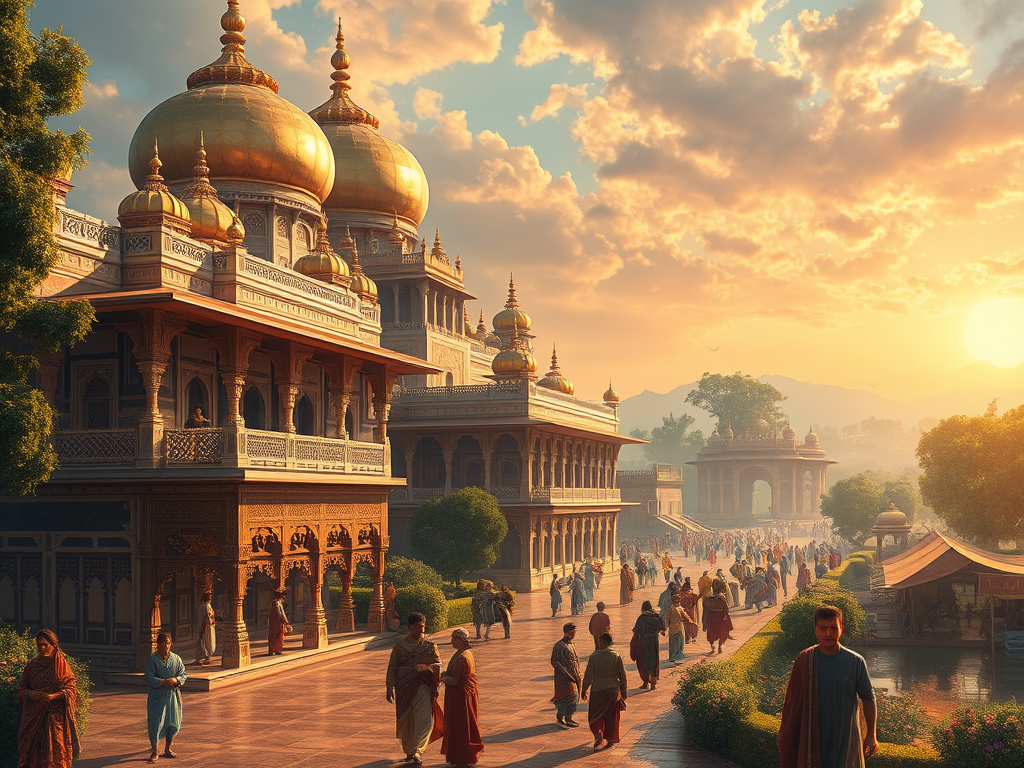
The exuberance and ostentation that had become synonymous with Mughal Nobility attracted visitors and traders from all over the world. The nobility lived in walled castles with harems, gardens fountains and large retinues of servants and slaves. In order to cater to their needs, a number of handicraft industries produced high quality cotton textiles, silks, jewellery, decorative swords and weapons. These luxury industries grew up in urban centres. The urban population was bigger in the Muslim period – almost three times that of its European counterparts – than it had been under previous rulers, for caste restrictions had previously kept artisans out of towns.
The Crown, the autonomous rajas, the High Nobles and the wealthy merchants all comprised the ‘Upper Class’ in under the Mughal rule. The sources of income extended beyond their personal salaries (zat) to considerable profits on the payment of their soldiers (tabinan). This meant that mansabdars simultaneously operated as merchants. The example of Mir Jumla who operated a fleet of ships across West and South-East Asia is indicative of the same.
The ‘trickle-down’ system of economy was in full swing under the Mughals as the ‘spending, not hoarding’ characteristic was prevalent among the majority of the ‘upper classes’ as affirmed by Moreland. The nobles themselves spent great amounts of money every single for the upkeep of their homes and harems – often at the cost of plunging themselves into great debt. Even Emperor Aurangzeb – a miser and puritan by many accounts – could not sojourn this opulent lifestyle of the Mughal ‘upper class’. The economy for luxury goods and the fine arts thrived during this era owing to the upper class’s cavalier attitude towards money.
In stark contrast to the workers who lived in cramped thatched houses, houses of most of the members of the ‘upper class’ were ostensibly decorated with the historical accounts of travellers narrating the rich tastes the nobles had in decorating their houses with fine cloth, grand furniture pieces and rich carpets among other things. A large sum was also spent on the maintenance of the stables. The nobles are also known to spend exuberantly on their diet – with records of Abu’l Fazl being prepared around one-hundred dishes daily. The “luxuries” at the dinner table included ice shipped all the way from the Himalayas, free-flowing jars of wine, the imported coffee, sherbet and a wide array of spices.
The mercantile class was one just as affluent (if not more) with businesses worth over eight million rupees and trades comparable to the East India Company operated by individual merchants. However, as per Bernier, they seldom led lifestyles akin to the spendthrift nobles owing to habits of frugality and fear of thefts. Nonetheless, the epic proportions of their affluence usually showed at weddings with the average Indian known to spend around four to five thousand rupees as per the accounts of Boccaro – a seventeenth-century traveller. The incident of a merchant Khemchand being robbed of fifteen lakh rupees – a sum he had borrowed for the wedding of his daughter – is astounding when compared to the fact Emperor Shah Jahan had spent thirty-two lakhs on the wedding of crown prince Dara Shuk’oh’ during the same time.
At its zenith, this stage of economic surplus had the potential of rapid economic growth had it been under the control of a modernised elite of capitalists as evident from Meiji Japan. However, with a surplus of the exchequer driven towards “luxuries”, precious metals and the construction of tombs and mosque of grandeur, the fiscal surplus was whittled down, was redistributed as rental income, and partially drained off in the colonial period. The State apparatus was parasitic and exploitative in nature and had terrible ramifications on production incentives in the agricultural sector. The productivity of the urban economy was caught out against the arbitrary demands of the State, making economic conditions ripe for the colonisation of India.
 Bhrigu A. Pamidighantam
Leave a comment